If any note can belong to any chord, every chord can in principle hold all twelve tones. This essay looks at twelve-tone chords, the overtone series, and serialism, and then at the scores where I put these ideas to work.
Twelve-Tone Chords
Pat Metheny suggests that all twelve tones can be a part of any chord, as upper extensions. When looking at the overtone series of each note of a chord we quickly see how this is possible. The implication is that all chords are related to one another, as they share the same notes. In other words: since all twelve tones can be a part of any chord, all chords are identical. All chords have the same notes. All chords have every tone in common. The main difference is the order of notes from the root, or bass note. An A-7 may have a G# many octaves above the root, whereas a G#maj7 has the G# in the bass. But both these chords share the same notes, and differ only by virtue of the distance between each note and the root. Likewise, all keys are related for this same reason.
All keys have every note, because all of the chords in that key can have all twelve tones. Therefore all chords in every key have all twelve tones, and all keys have all chords. Basic diatonic chords— Maj7, m7, dominant 7, -7b5—can exist on any of the 12 notes of the chromatic scale in relation to a key’s center.
A Pat Metheny lesson (Metheny, n.d., p. 3) from the Internet provides an example of how it’s possible to hear all 12 tones in relationship to any chord, as part of the structure of that chord. A student asked Metheny about chromatic sidestepping or side-slipping, similar to the playing of Michael Brecker. Metheny responded:
It’s taken me a long time, but with the exception of the major 7 or minor 7 chord, I can hear any note as a part of any chord. If I play a note I hear all the notes leading up to that note. Chords have all the notes in the upper structure way up high. I hear them and just play them down in the regular register.
What Metheny played, appended with my observations, appears with my observations.
In the first two bars, Metheny plays an F# and B against a C tonic.
He shows us how his ear relates to these notes as a part of a D major triad in the Key of C. In the fourth system he shows us how his ear accesses several notes that might not be considered C7.
Also of note is the B, the 7 against the C7. He hides the B at the bottom of a B major 7 arpeggio, starting on A# (Bb). In the 6th system he shows us how he hears upper extensions against a C7#5. He plays 1, 3, #5 (b6), 8 (1), b12 (b5), 13 (6), 15 (1), 18 (4), and b17 (b3). Against a C7#5, he hears all of these notes as being part of that chord – 1, b3, 3, 4, b5, #5, 6 – not to mention the b7, which he played when he sounded the chord. Metheny then takes those upper extensions and plays them lower down in the register. In the last system against the C7#5, he is able to hear 1, b2, b3, 4, b5, 5b5, b7, and the 3, which was sounded in the chord.
If we accept Metheny’s statement that every note belongs to every chord, the 4 has its place somewhere in the structure of a Imaj7 chord. Traditionally, we wouldn’t think of the 4 as part of the Imaj7 and in fact, it is commonly taught to be considered an “avoid” note. But the 4 may belong to the upper structure of the Imajor chord, at least two octaves up. It might be more appropriate to consider these “incomplete” dominants and subdominants, because they contain the 4 of the key.
Musician and composer Richard Niles has known Metheny for more than 30 years and has compiled 20 years of interviews he’s conducted with Metheny (Niles, 2009). In an online interview with Niles, (R. Niles, personal communication, April 12, 2012). I asked how Metheny is able to hear and incorporate any note as part of any chord. Niles stated that Metheny’s ears are incredibly sensitive and accurate. He’s able to hear overtones that most of us cannot.
Overtones
Overtones are tones that sound along with a fundamental frequency. They are produced by positive interference; nodes in the sound wave will peak higher as a vibration returns along a string or through a column of air. The most prominent peaks occur at simple ratios of frequencies and represent the tones most easily heard above the fundamental. When one pitch is sounded, consider all the notes from the series being sounded also. Listening closely, one can hear overtones along with the fundamental.
The overtone series enables any note to be part of any chord.
Look at the overtone series as a vertical structure, with its accompanying diatonic notes. Consider the possibilities when a major scale is played: What other notes are being sounded as we play a major scale? Consider Gbmaj7 in relation to a C tonic: What can be said about C’s overtone series, Cmaj13’s overtone series, and C-maj7’s overtone series?
Composer Arnold Schoenberg (1978) wrote that C’s closest cousin is G, because the G is the first different note in C’s overtones series. If I understand him correctly, for this reason G is C’s closest cousin. And F is C’s close relative, because C is the first different overtone of F. Schoenberg (1978) believes these relationships lay the foundation for the diatonic scale. The first different overtones of C are E and G. The first different overtones of F are A and C. The first different overtones of G are B and D. (So c, e, g, b, d, f, and a, or rearranged c, d, e, f, g, a, and b.) He considers C to pull towards and be dependent on G, and for C to pull towards and be dependent on F. He believes C is stuck in the middle, pulled in both directions:
A chord is a composite sound consisting of at least three different tones, hence, a, also of four, five, six, etc. This ‘etc.’ however, does not hold; for theory hardly acknowledges five tones—even the ninth chords arouse ‘doubt in the hearts’ of the theorist, instead of thought in their brains (pp. 23-24).
Below is an illustration of overtones which are sounded when a pitch is created.
The first measure shows all the tones that are sounded against a pitch. The second measure shows where in the overtone series a triad comes from, and how the fundamental and first two different overtones make a major triad. The third measure demonstrates what register is sounded by the overtone series of a major 7 chord, the fundamental. The third overtone is the perfect 5th, the 5th overtone is the major 17th (3rd), and the 15th overtone is the 21st (major 7th).
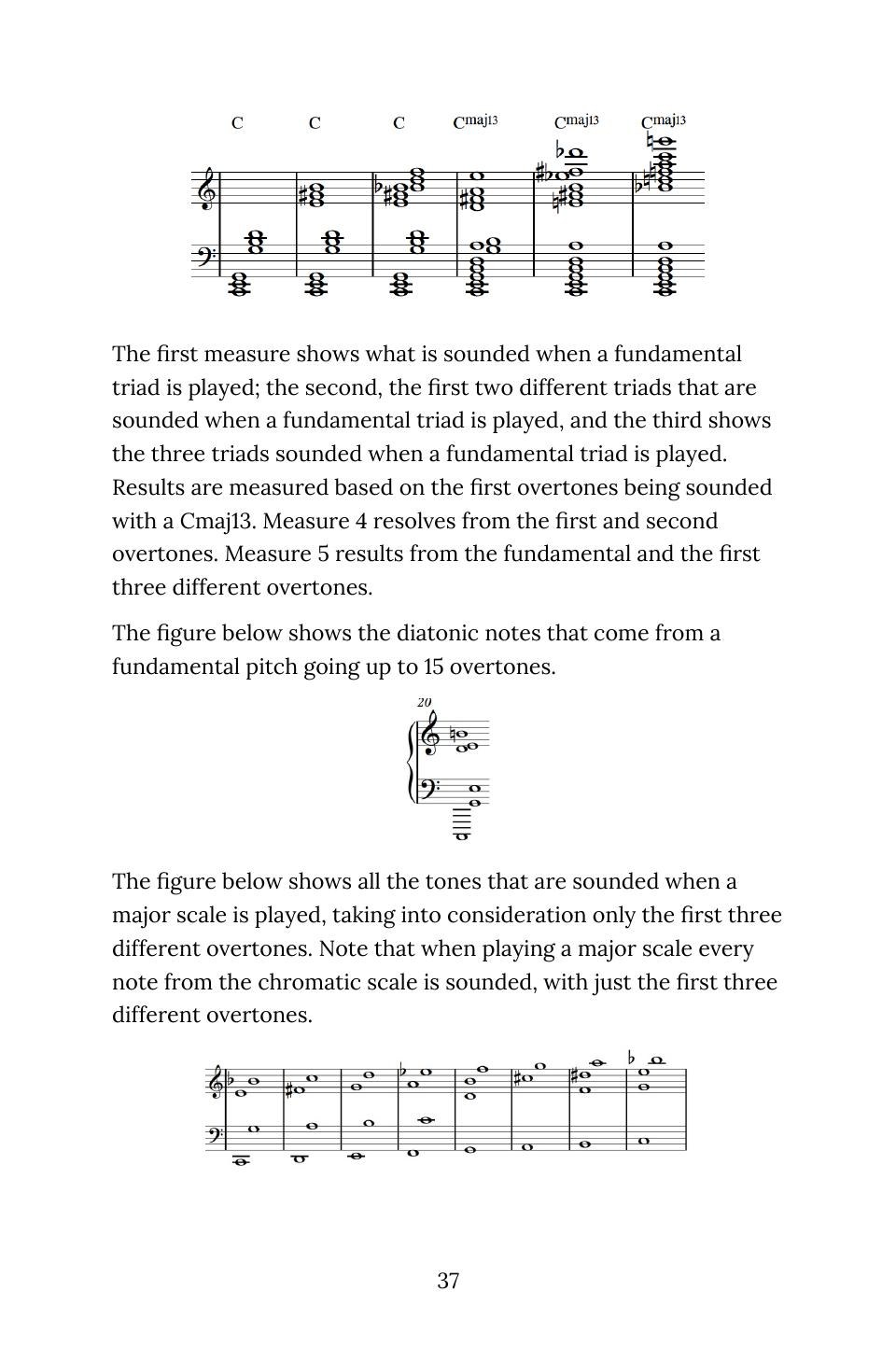
The following figure demonstrates overtones and chords.
The first measure shows what is sounded when a fundamental triad is played; the second, the first two different triads that are sounded when a fundamental triad is played, and the third shows the three triads sounded when a fundamental triad is played.
Results are measured based on the first overtones being sounded with a Cmaj13. Measure 4 resolves from the first and second overtones. Measure 5 results from the fundamental and the first three different overtones.
The figure below shows the diatonic notes that come from a fundamental pitch going up to 15 overtones.
The figure below shows all the tones that are sounded when a major scale is played, taking into consideration only the first three different overtones. Note that when playing a major scale every note from the chromatic scale is sounded, with just the first three different overtones.
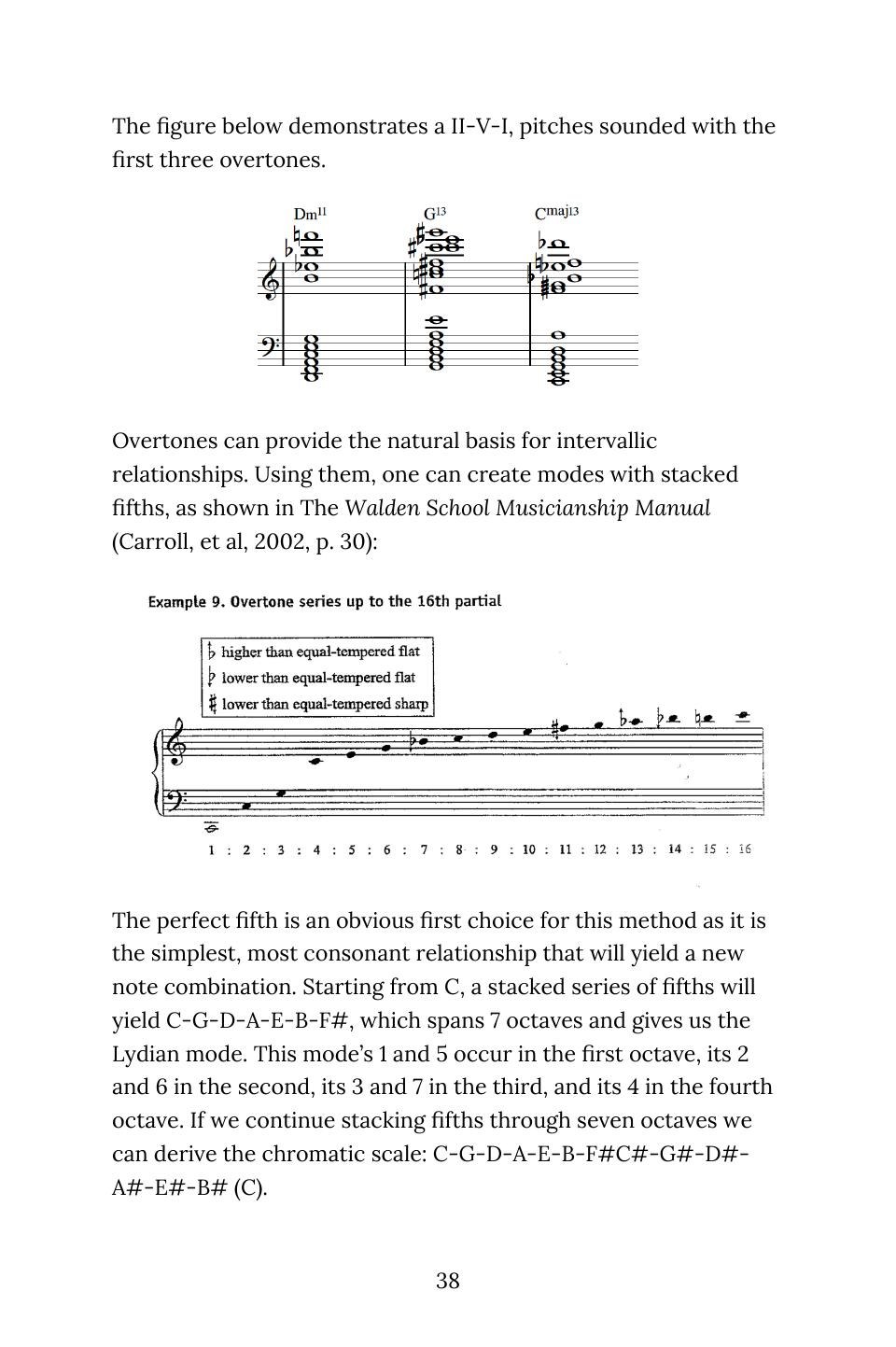
The figure below demonstrates a II-V-I, pitches sounded with the first three overtones.
Overtones can provide the natural basis for intervallic relationships. Using them, one can create modes with stacked fifths, as shown in The Walden School Musicianship Manual (Carroll, et al, 2002, p. 30):
The perfect fifth is an obvious first choice for this method as it is the simplest, most consonant relationship that will yield a new note combination. Starting from C, a stacked series of fifths will yield C-G-D-A-E-B-F#, which spans 7 octaves and gives us the Lydian mode. This mode’s 1 and 5 occur in the first octave, its 2 and 6 in the second, its 3 and 7 in the third, and its 4 in the fourth octave. If we continue stacking fifths through seven octaves we can derive the chromatic scale: C-G-D-A-E-B-F#C#-G#-D#- A#-E#-B# (C).
When a fundamental sounds, many other tones sound along with it because of the overtone series. Depending on how many steps of the series we are willing to recognize, a single tone contains almost a complete diatonic scale and almost the complete chromatic scale. If we play a major scale and take into account only the first three different overtones, we already have a completely chromatic environment. When we play a II-V-I cadence, the first three different overtones are sounding, whether we hear them or not, so each chord is completely chromatic: the Imaj7 contains all 12 tones, the II-7 contains all 12 tones, and so does the V7. The difference in function among these chords, whether tonic, subdominant, or dominant, may therefore depend less on which notes each chord contains than on the order of its notes and each note’s distance from the root. The overtone series shows that every chord does in fact contain all 12 tones. It also shows that many of these so-called key centers are more closely related than we might first think, since chords may share more common tones than is generally assumed.
Developing 12-tone chord structures requires minimizing tension, and educator F. G. J. Absil (2007) developed rules to do so:
Rule 1: Use 4-part chords from the basic set presented in Table 1 or Fig. 1 in each layer.
Rule 2: Prevent or minimize the total number of intervals of the minor 9th between the pitches in adjacent layers (p. 2).
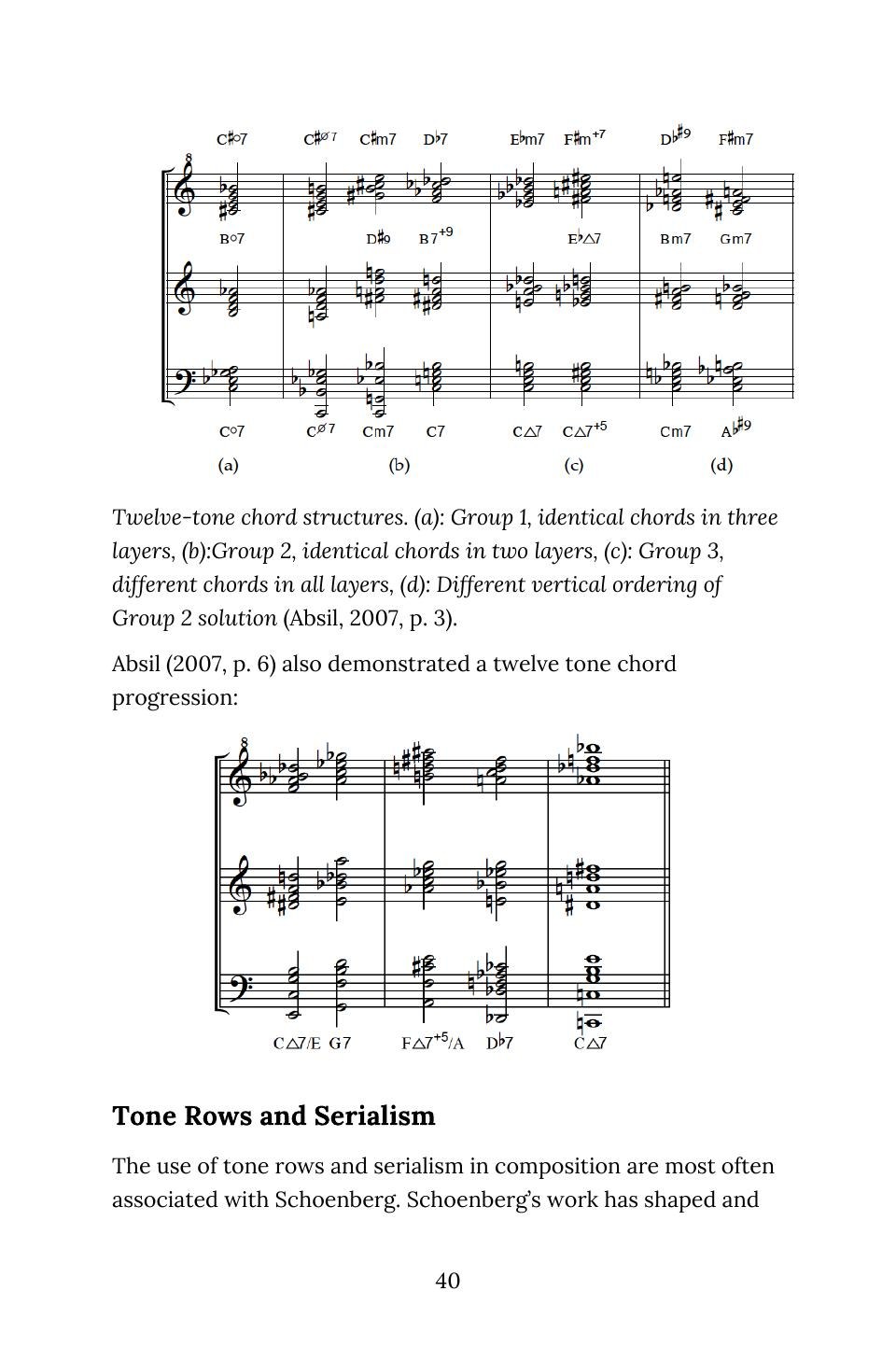
Twelve-tone chord structures. (a): Group 1, identical chords in three layers, (b):Group 2, identical chords in two layers, (c): Group 3, different chords in all layers, (d): Different vertical ordering of Group 2 solution (Absil, 2007, p. 3).
Absil (2007, p. 6) also demonstrated a twelve tone chord progression:
Tone Rows and Serialism
The use of tone rows and serialism in composition are most often associated with Schoenberg. Schoenberg’s work has shaped and
informed my concept of tonality and chromaticism. Although he is famous for tone rows and Serialism, he also made brilliant observations about functional harmony and tonality. His theory of tonal function states that a tonal work’s function, both specific and general, is related to the central tonality of the whole work, which in turn is represented by his principle of monotonality. This principle states that “every digression from the tonic is considered to be still within the tonality whether directly or indirectly, closely or remotely related … There is only one tonality in a piece” (Schoenberg, 1989, p. 19). My acceptance of all pitches in tonality is derived from Schoenberg’s work.
Twelve-tone technique became very popular amongst twentieth century composers. Stravinsky began using it towards the end of his career. Schoenberg’s disciples, including Webern, carried it well into the century. Schoenberg himself wasn’t at all opposed to using triadic structure, although it seemed that its main purpose was to avoid tonality at all costs. It eventually became conventional to avoid triads and any sort of traditional harmony.
Alexander Graham (2005, pp. 48-49) attempted to use tone row to play over “All the Things You Are.” In doing so, Graham provided the following useful guidelines:
Three basic principles are employed in an attempt to justify prevailing tonality within the tonal confines of the chord changes…:
1. Justifying the notes through the existing chords,
2. Justifying the notes through implied chord substitutions, and
3. Justifying the notes through use of target or “goal” notes that fit
into smaller or larger “goal note” or guide-tone sequences. (p. 26)
Graham felt these steps were the most effective because: …[T]hey allow for the true character of the twelve-tone sound to be expressed without being dulled by the traditional rules of harmony. Instead of using implied chord changes or even upperextensions to justify the notes, the construction of the row acts as its own justification and in the best examples, this is apparent to the listener. Instead of creating dissonance by using substitution chords to embellish the V-I relationship, these rows use patterns that create a kind of linear dissonance.
Graham cites rows # 6, 9, 13, 22 and 25. “These leaps create a unique sound and tension that is not commonly found in improvised jazz solos which tend to lean on scales and patterns of thirds, fourths and sixths for the majority of its material.” (p. 28).
Graham further wrote that this approach allows notes that are completely outside of the chord (e.g., a major 7 on a dominant chord) to be effectively used without relying on the traditional use of non-harmonic notes. When these phrases are prepared and concluded properly, they do not sound ‘free’ or ‘out’ just for the sake of being so, but complete a tonal resolution. (pp. 27-28).
I have incorporated twelve-tone technique into my playing and writing. Besides using tone rows to incorporate melodies as preexisting chord changes, one could also use the rows to write chord changes, using, for example, tone row in the bass or root movement of a chord progression, or as the melody note (each note gets its own chord). A good starting place might be to use parallel movement to give structure to your tone row harmonies.
Twelve-tone technique and serialism force composers to concentrate on structures other than tonality. Without the glue that tonality provides, composers must look for more interesting things to do with rhythm, texture, timbre, density, and space.
Eventually music theory must develop a profound way to talk about this music. The theory should define and analyze music ranging in diversity from Charlie Parker to Cecil Taylor, from Steve Coleman to Sun Ra, applying to each the same system, method, and vocabulary.
Scores and Harmonic Studies
Harmony
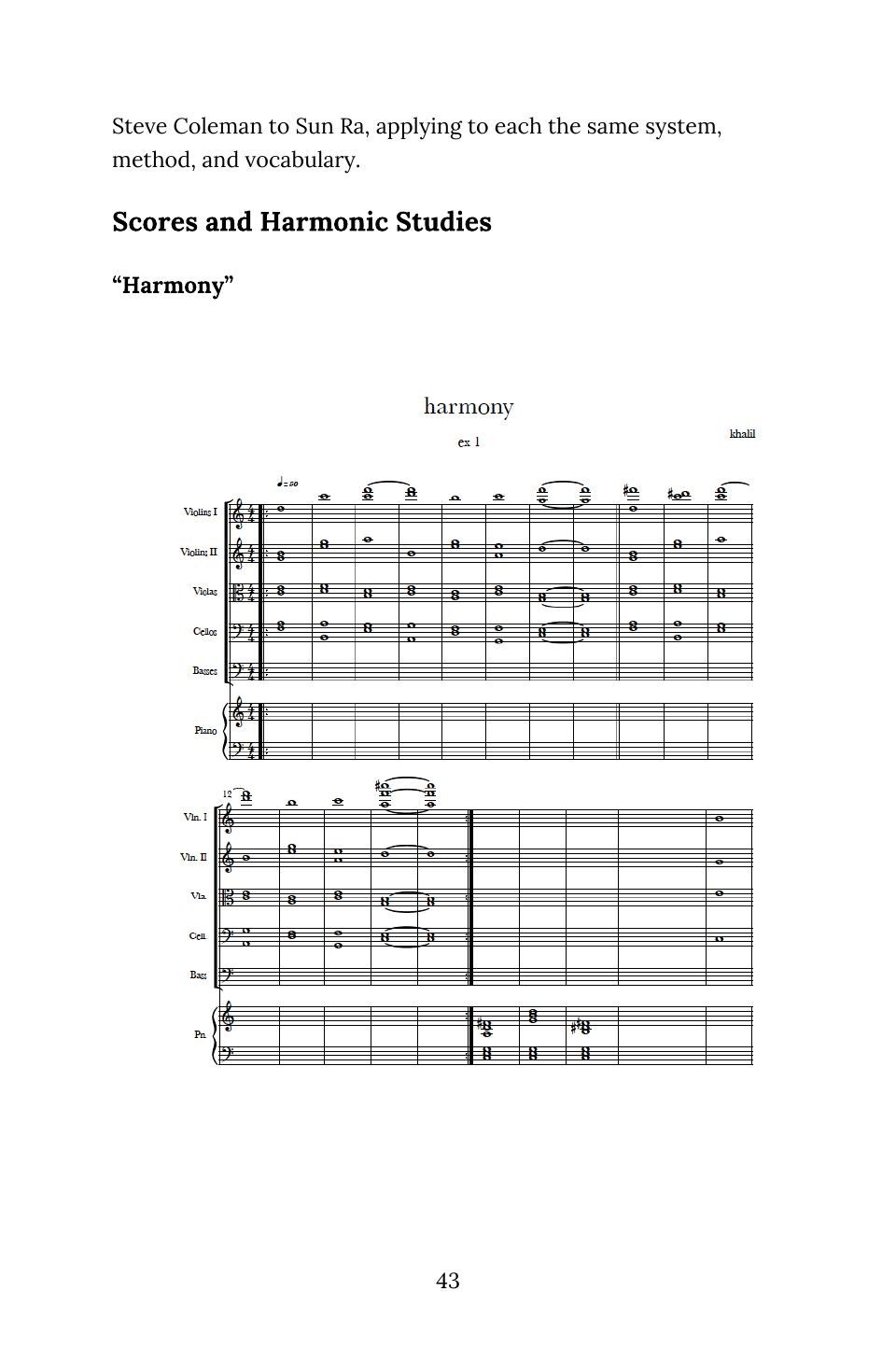
This example comes from my research into seven-note chords.
Eventually, I’d like a language of twelve-note chords defined by the order of their pitches; if every chord contains all twelve notes, order is what distinguishes them. In “Harmony,” I harmonized a diatonic scale so that each chord contains every pitch of the scale, and function is determined by pitch order. The example is in C major. It starts on the IV chord and moves through the cycle of fourths until it finally resolves on the I chord. Every chord contains all the diatonic pitches, but the order of the pitches from the bass up determines chord quality and function. Even though every chord has the same seven pitches, I assert that the IV chord functions as subdominant, the VII as dominant, the III as tonic, the VI as tonic, the II as subdominant, the V as dominant, and the I as tonic.
“7-Note Diatonic Chord, Cycle of Fourths”
For this song, I appropriated the drum sounds from Lorde’s “Royals.” I tracked three guitars: two play the chords, and the third plays through a dotted-eighth delay. These are what I consider functional seven-note chords in the cycle of fourths: B-7b5/E-7 E-7/A-7 A-7/D-7 D-7/G7 |
“-77maj7”
About my composition “-77maj7,” suffice it to say that I used what I consider the primary subdominant, dominant, and tonic chords: II-7 (ii -7/5/3), V7 (V -7/5/3), and Imaj7 (I -7/5/3). I move these chord qualities around in chromatic, nondiatonic, or irregular ways; for example, D-7 (D, F, A, C) moves to Eb7 (Eb, G, Bb, Db) and “resolves” to Gbmaj7 (Gb, Bb, Db, F). And although the pulse is regular, the harmonic rhythm is irregular and unpredictable.
Composing “-77maj7” led me to some successful ideas that I want to explore further.
String Quartet
Below the score is a harmonic analysis of a short piece I wrote.
The piece itself is “cheesy,” but its use of harmony and harmonic rhythm is relevant to my music and to this writing.
String Quartet analysis:
1st measure: C7/Bb.
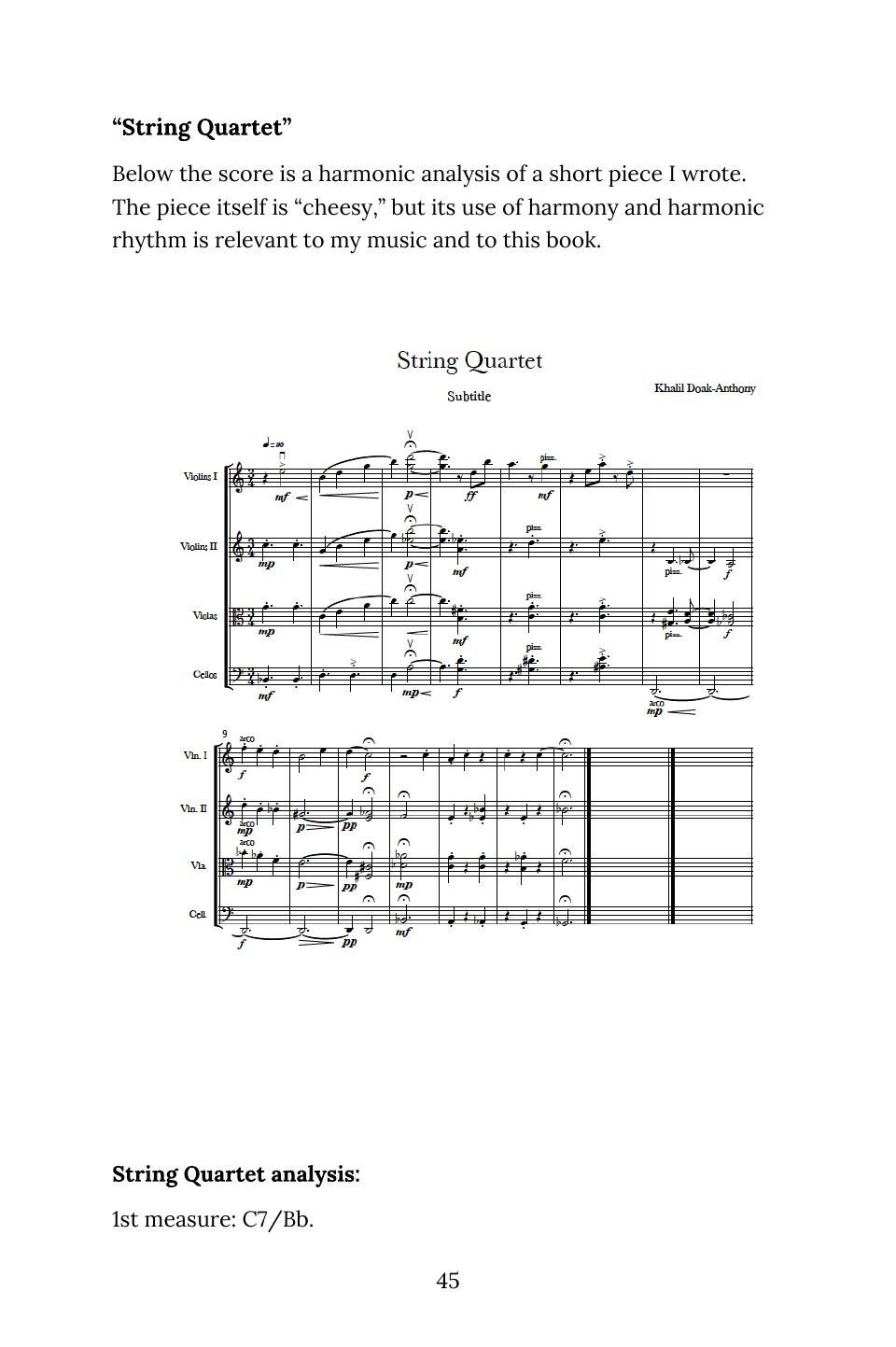
2nd measure: D13sus. This chord carries over through the first beat of the third measure. Note the shifting harmonic rhythm.
3rd measure, 2nd beat: A-11b5 (with a 9 as well), which carries over into the next measure for a dotted quarter.
4th measure, beat 1.5: B/Gmaj7
5th Measure, beat 1.5: G#maj7#11
6th Measure, beat 1.5: C9/Bb
7th Measure, beat 2: E/D
7th Measure, last eighth note: Bbmaj7/D
8th Measure, second beat: D6
9th measure: beat 1, Bb/D; beat 2, E7/D; beat 3, incomplete chord E7b5/D
10th Measure - E7/D
11th measure, second beat, from the bass up: D, F#, C#, E, Ab (G#), and C. Note the use of C, C#, and D. I could call this C#minmaj7/Dmaj9.
12th Measure: Bb-9
13th Measure, beat 1: Amin7
13th Measure, beat 3: Abmaj9
14th measure, beat 2: Gmaj7 or Gmaj13 (enharmonic spelling; I could have written the Gb as F#)
15th measure, beat 1: Note the quarter-note anticipation of the last chord. From the bass up, this chord is Gb, F, Bb, and C, and could be called Gbmaj7#11.
Harmony in Succession:
C7/Bb - D13sus - Amin11b5(9) - B/Gmaj7- G#maj7#11- C9/Bb - E/D -Bbmaj7/D -D6 - Bb/D-E7/D -E7b5/D- E7/D - C#minmaj7/Dmaj9- Bbmin9 -Amin7 -Abmaj9 -Gmaj13 - Gbmaj7#11
What can be said about these chords?
What can be said about the movement between these chords?
What style of harmony is this?
Brass
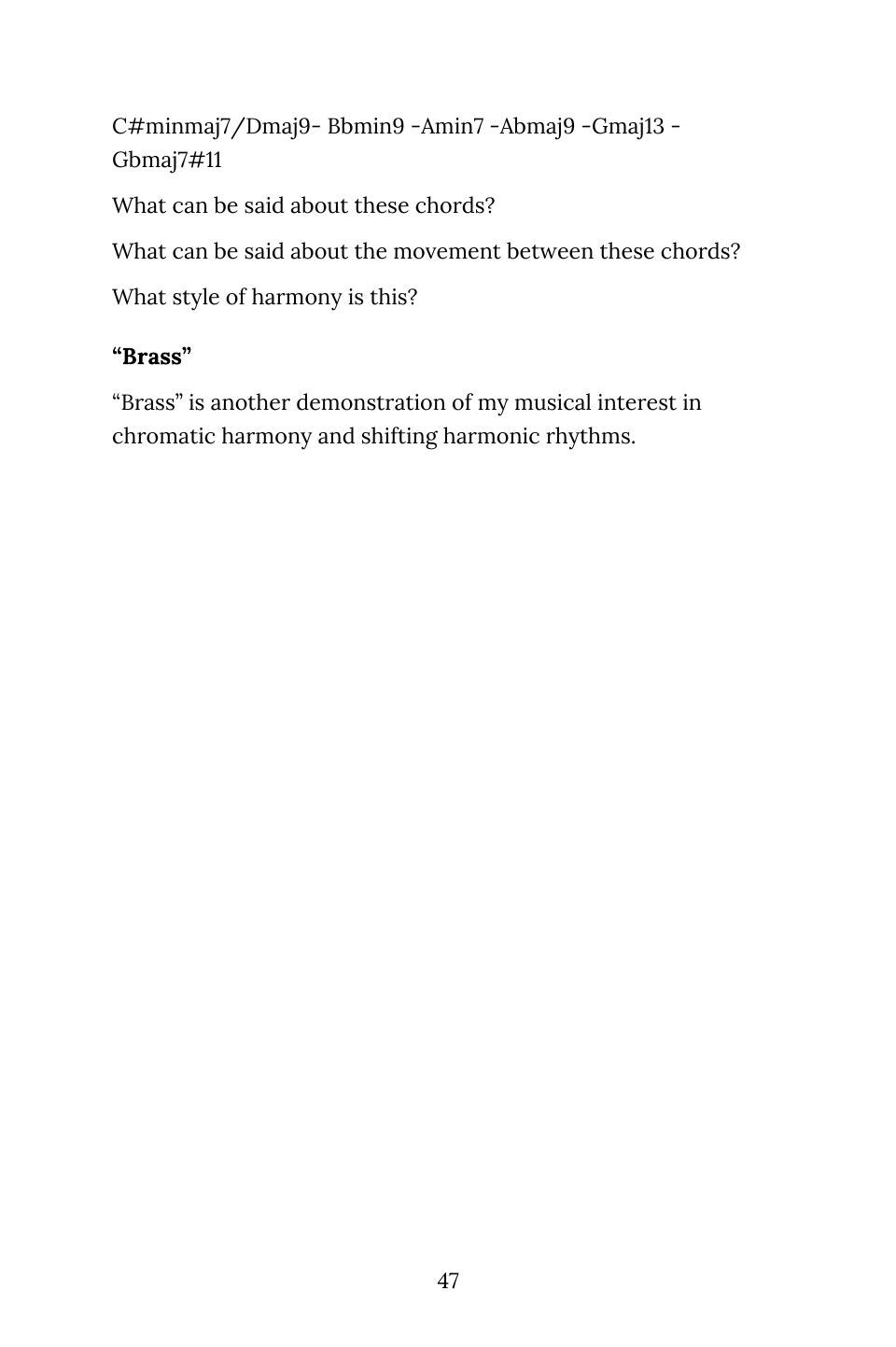
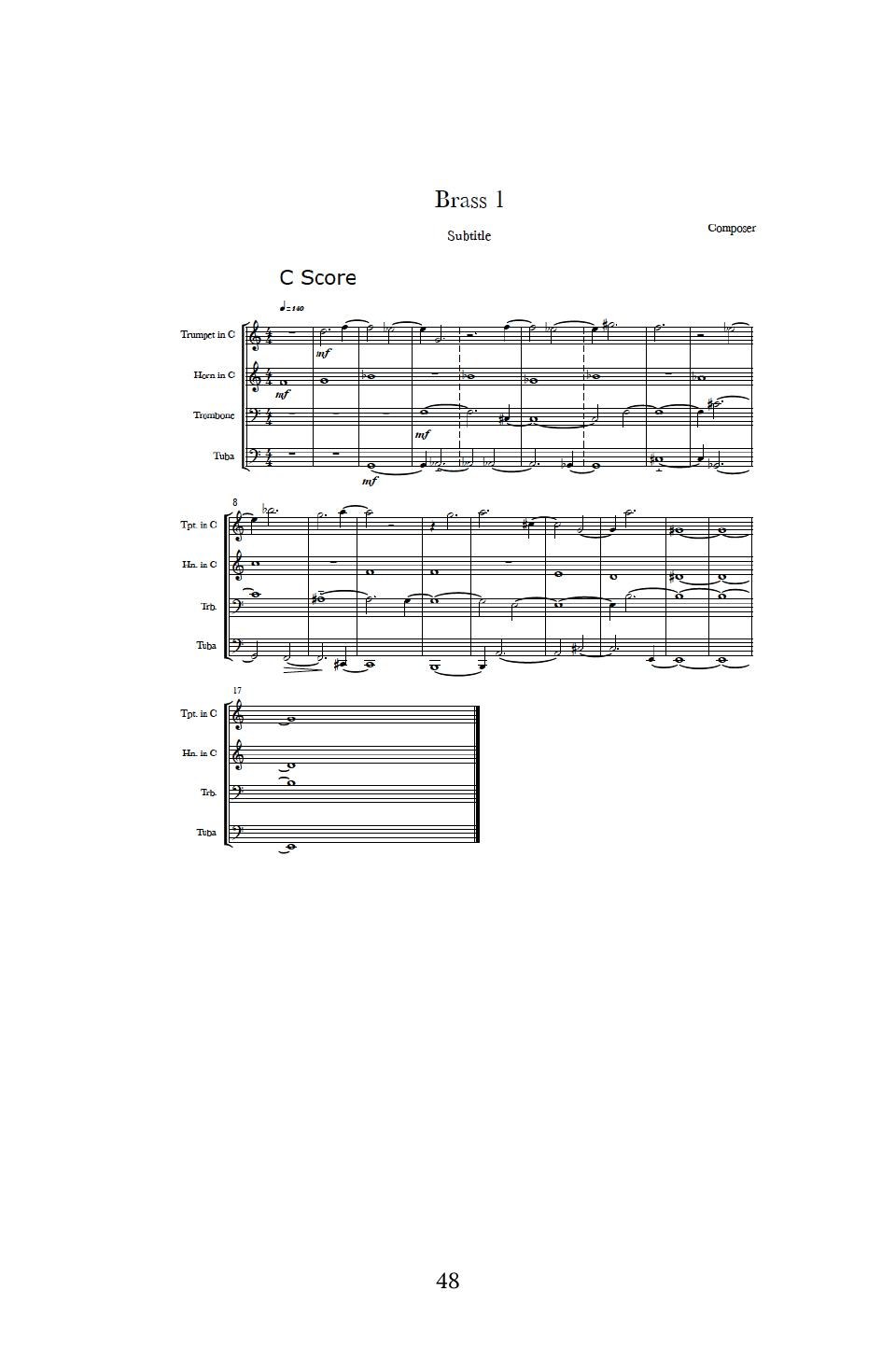
“Brass” is another demonstration of my musical interest in chromatic harmony and shifting harmonic rhythms.
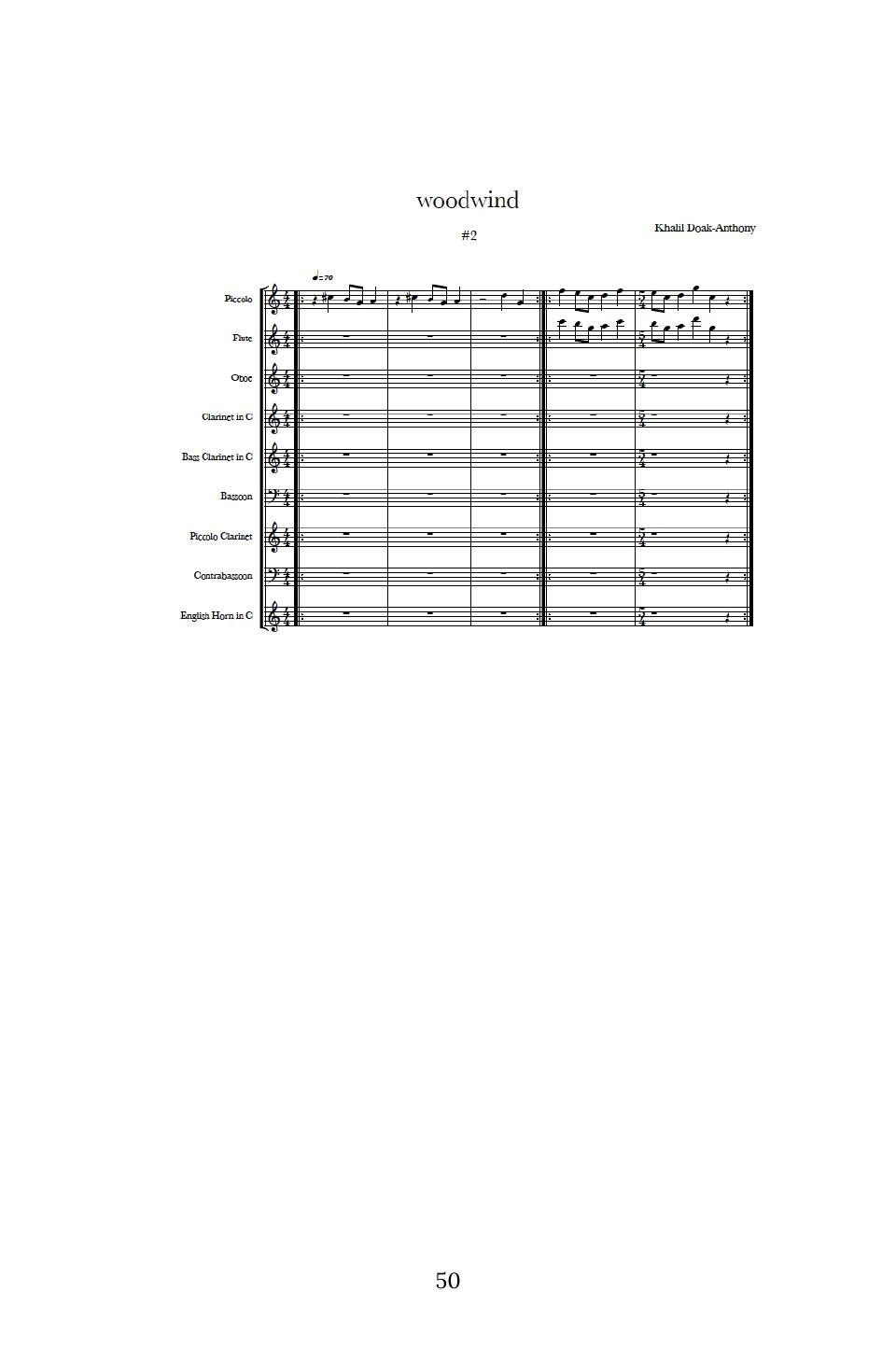
Woodwind

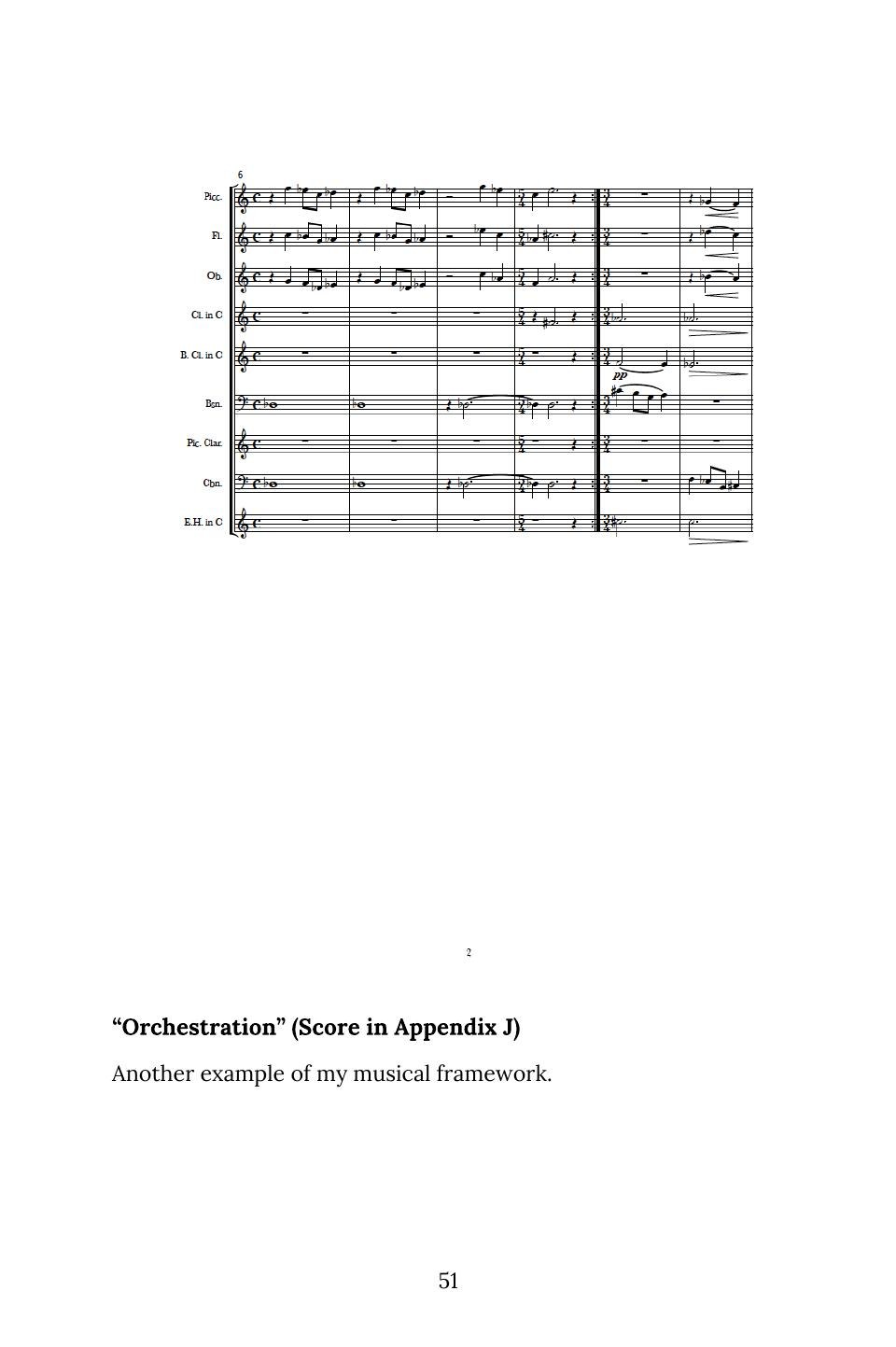
“Orchestration”
Another example of my musical framework.