Parallel and symmetrical harmony move chords through the chromatic scale by structure rather than by key. This essay traces the theory, follows it into the music of guitarist Ben Monder, and then into two of my own pieces, “Ouch” and “Trio.”
Parallel Harmony
Parallel harmony, also known as constant structure, or planing, refers to a chord progression that uses the same vertical structure. Parallel harmony provides a framework for moving chords around in a chromatic environment, in or out of the key.
The order provided by the constant structure allows the ear to follow that structure through any and all possible options offered by the chromatic scale. This concept of chromatic tonality impacts our notions of function with regard to how these chords are related tonally. Anytime we see a chord of a certain quality move to another chord of the same quality, we can say this is parallel harmony (e.g., Cmaj7-Dmaj7).
We can use constant structure/parallel harmony to move through all of our modes while keeping the same chord structure, as demonstrated below.
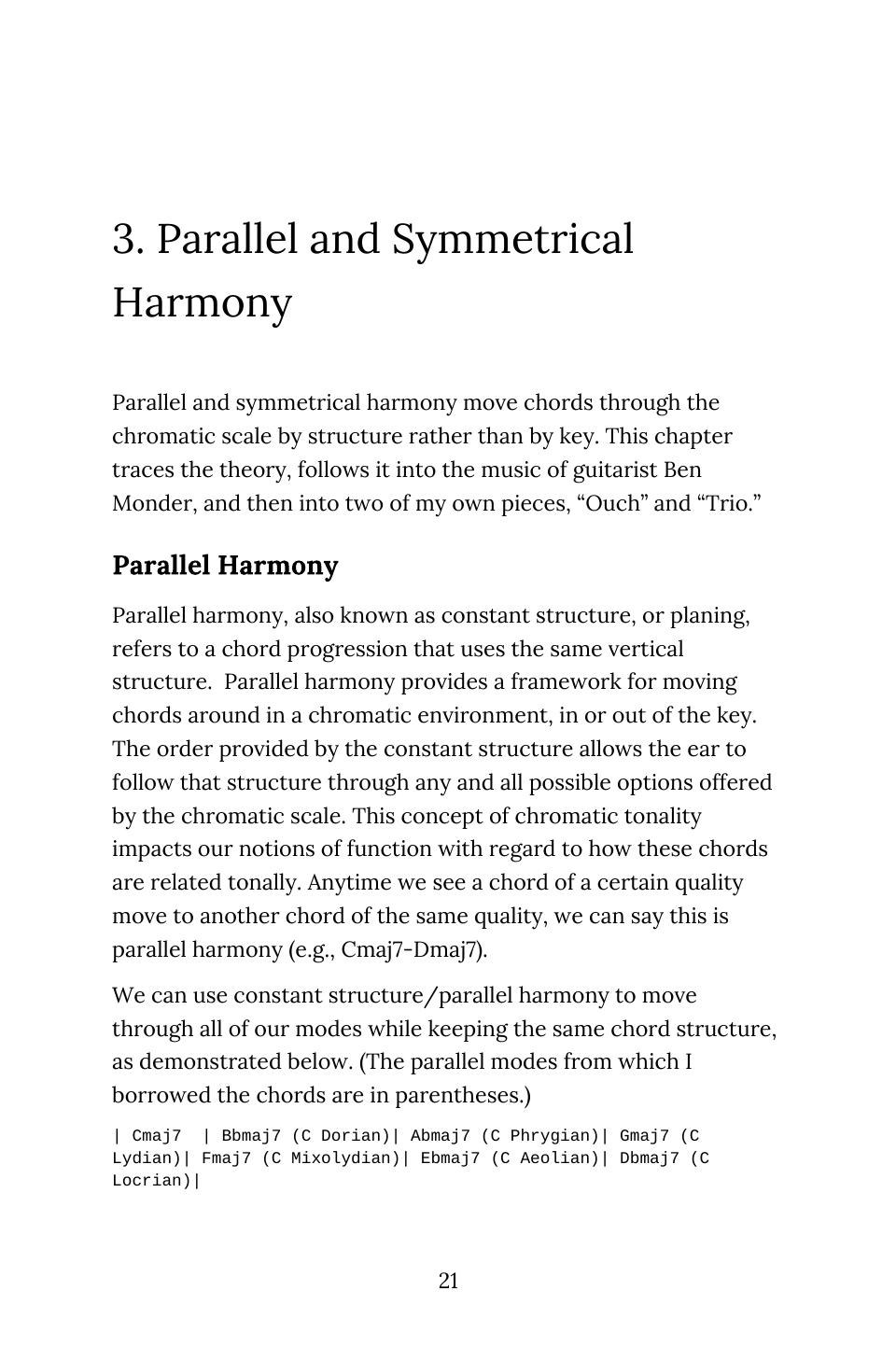
The parallel vertical movement gives our ear a point of reference throughout the movement. Preserving the key center is not necessary.
Here’s an example of how constant structure can be used to maintain order outside a key:
Here, I used parallel motion to harmonize an escalating scale pattern, inspired by the following Slonimsky “scale” (1978, p. 186) example.
This “scale” demonstrates increasing and diminishing intervals.
Ascending or descending, each movement increases a half step.
The first movement is a half-step, the second a whole step, the third a minor third, etc. I used this idea to construct the foregoing example of parallel harmony, so my root movement was: C, Db, Eb, Gb, Bb, Eb, A, E, C, A, G, Gb. Coincidentally, this is an octatonic scale, starting with a half-step. The following demonstrates the scale: C, Db, Eb, E, Gb, G, A, B. I harmonized this escalating “scale” pattern using parallel m9th chords.
Symmetrical Harmony
Techniques of symmetrical harmony give further structure to parallel harmonic movement. In the mid-20th century, both Joseph Schillinger and Nicolas Slonimsky recognized and wrote about the system of symmetrical movement. Each divided octaves and multiple octaves into symmetrically equal parts, and used this symmetry to develop new “synthetic” scales. Some of these scales are contained within one octave and others span many octaves before repeating.
Jazz musicians have employed symmetrical harmony, multi-tonic key systems to great effect. The technique can be heard on the bridge of Have You Met Miss Jones (Hart, L. and Rodgers, R., 1937), as well as the bridge of Seven Steps to Heaven (Davis and Feldman, 1963). Contemporary musician Ben Monder provides a strong example in his tune Oceana, which is explored later in this writing.
It’s also evident in such John Coltrane compositions as Giant Steps, Count Down, and Central Park West, and is the basis for the well-known “Trane” II-V. It’s common knowledge that Slonimsky’s work had a big impact on Coltrane.
The structure of symmetry is said to provide order in the absence of a key center. But do commonly employed methods of using symmetrical harmony, multi-tonic key centers allow for actual polytonality? Let’s explore whether more than one key center can exist simultaneously.
Symmetrical harmony gives order to parallel harmony by providing symmetrical movement in the octave or octaves. The ear can follow the symmetry of the movement, whether it takes place in major thirds or minor thirds. Our idea about multi-tonic key centers comes into question. Are there multiple key centers or is there only one? Typically a tune like Giant Steps is said to move through three keys. Indeed, it moves through three scales.
But in light of a chromatic tonality, perhaps Giant Steps is in the key of Eb, and all the other chords should be seen as revolving around this tone. When the root of any parallel harmonic structure moves in symmetrical increments, whether dividing one octave into equal parts or multiple octaves into equal parts, it can be considered to be symmetrical harmony (e.g, Cmaj7-Gbmaj7- Cmaj7, Cmaj7-Emaj7-Abmaj7-Cmaj7, Cmaj7-Ebmaj7-Gbmaj7- Amaj7-Cmaj7, etc.) Although this concept in its most basic form dictates that we complete the symmetry, starting and ending on the same chord, in practice we sometimes encounter partial or incomplete symmetrical movement (e.g., Cmaj7-Ebmaj-Gbmaj7- Amaj7). Grantham (1993, p. 51) explained that at times the symmetry is hidden via the use of chord substitutions. Tonic chords can substitute for each other, as can subdominant and dominant chords. Examples follow.
Well-established chords that function in the key of C: Cmaj7 (tonic)-Dm7 (subdominant)-Em7 (tonic)-Fmaj7 (subdominant)-G7 (dominant)-Am7 (tonic)-Bm7b5 (dominant). Tonic chord symmetry with substitutions: Am7 (Cmaj7)-Bbm7 (Gbmaj7)-Em7 (Cmaj7).
Subdominant chord symmetry with substitutions: Fmaj#11 (Dm7)- Abm7 (Abm7)-G7sus (Dm7). (Note: the G7sus function is subdominant in the key of C, like the Dm7.) Dominant chord symmetry with substitutions: G7 (G7)-Fm7b5 (Db7)-Bm7b5 (G7).
Examples of symmetry follow: In the same way, you can divide five octaves into 12 equal parts at intervals of perfect fourths, divide seven octaves into 12 equal parts at intervals of a perfect fifths, divide 10 octaves into six equal parts at intervals of minor sevenths, and divide 11 octaves into 12 equal parts at intervals of major sevenths.
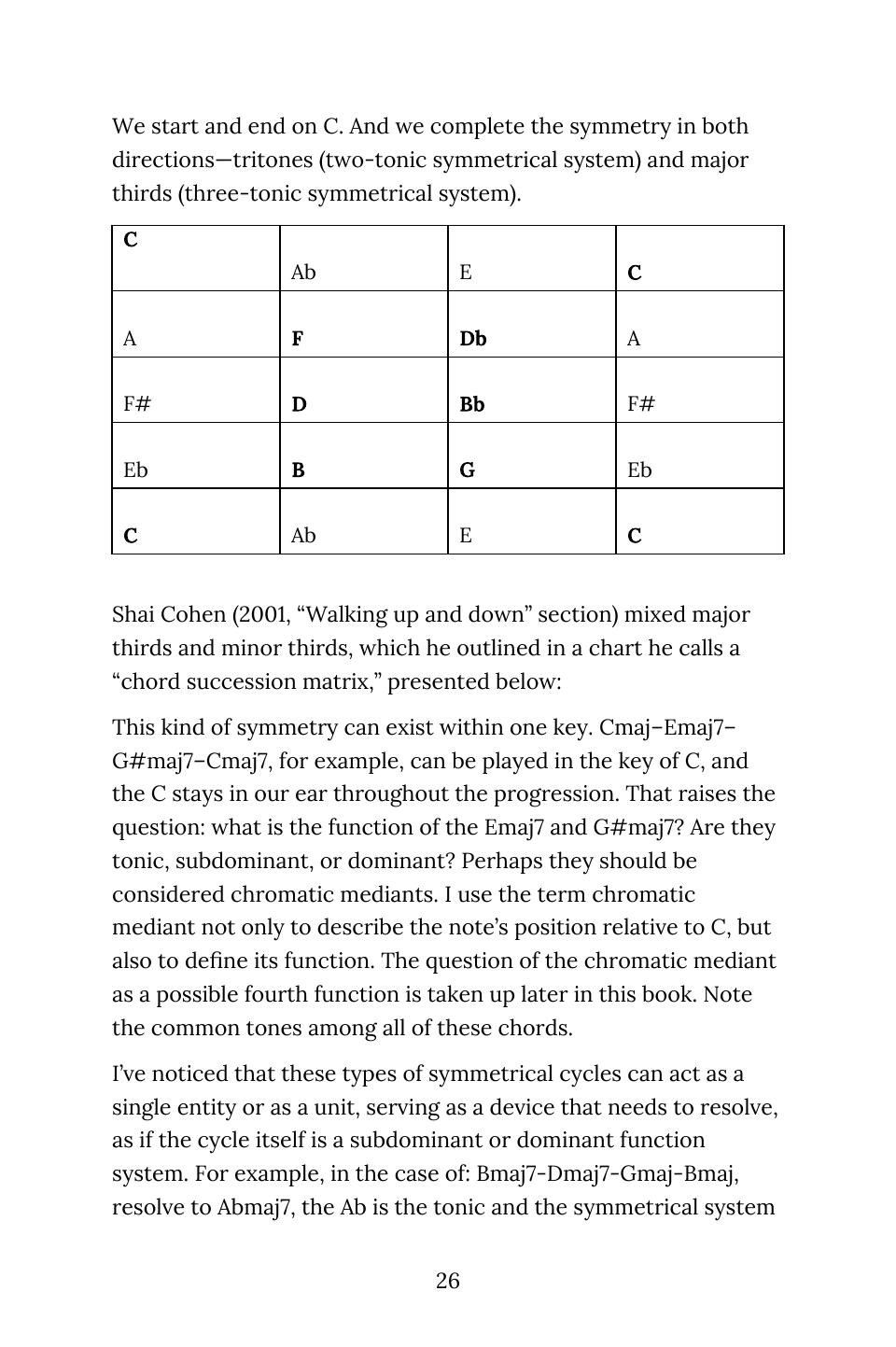
You can mix symmetrical movement and use any and all symmetrical intervals when integrating mixed symmetry. I encountered this idea in a paper on symmetrical harmony written by educator and composer Shai Cohen (2001), and it makes perfect sense. The key is to start and end on the same chord, and to complete the symmetrical motion of every interval. In other words: if using two-tonic symmetry, you must make three chord changes, from C to Gb, and back to C. If you want to mix the twotonic symmetrical system with the three-tonic symmetrical system, it would look like this: Cmaj7-Gbmaj-Bbmaj7-Emaj- Abmaj7-Dmaj7-F#maj7-Cmaj7.
We start and end on C. And we complete the symmetry in both directions—tritones (two-tonic symmetrical system) and major thirds (three-tonic symmetrical system).
Shai Cohen (2001, “Walking up and down” section) mixed major thirds and minor thirds, which he outlined in a chart he calls a “chord succession matrix,” presented below:
This kind of symmetry can exist within one key. Cmaj–Emaj7– G#maj7–Cmaj7, for example, can be played in the key of C, and the C stays in our ear throughout the progression. That raises the question: what is the function of the Emaj7 and G#maj7? Are they tonic, subdominant, or dominant? Perhaps they should be considered chromatic mediants. I use the term chromatic mediant not only to describe the note’s position relative to C, but also to define its function. The question of the chromatic mediant as a possible fourth function is taken up later in this writing. Note the common tones among all of these chords.
I’ve noticed that these types of symmetrical cycles can act as a single entity or as a unit, serving as a device that needs to resolve, as if the cycle itself is a subdominant or dominant function system. For example, in the case of: Bmaj7-Dmaj7-Gmaj-Bmaj, resolve to Abmaj7, the Ab is the tonic and the symmetrical system
holds the tension. Conventional thought says that these symmetrical systems should be considered multi-tonic or polytonal, having more than one tonal center.
While it’s generally taught that symmetrical harmony employs the use of multiple tonal centers, an awareness of modal borrowing and the options it offers provides the perspective that the socalled key centers are related, suggesting the possibility of only one tonal center. Moving between Cmaj7 to Gbmaj7 and back to Cmaj7 is an example of symmetrical harmony using two tonal centers. This movement can also be seen as modal borrowing, using the C-Ionian mode and then borrowing from the C-Locrian mode to derive our Gbmaj7. This technique can be seen in many of the symmetrical harmonic-based compositions.
Ben Monder Biography
Ben Monder is a contemporary figure of the progressive jazz scene whose work is relevant to this discussion. Monder composes, performs, and conducts workshops internationally. He has performed on more than 100 albums as a sideman, and as a band leader has released four CDs: Oceana (Sunnyside, 2005), Excavation (Arabesque, 2000), Dust (Arabesque, 1997), and Flux (Songlines, 1995). He has performed with the Maria Schneider Jazz Orchestra, the Paul Motian Octet, Jack McDuff, Theo Bleckmann, Marc Johnson, Bill McHenry, Lee Konitz, George Garzone, Tim Berne, and Kenny Wheeler. He served on the faculty of the New England Conservatory from 2002-2005.
As a child Monder took up guitar after first trying the violin.
Growing up in suburban New York, he listened to The Beatles, Jimi Hendrix, Jeff Beck, Eric Clapton, and Jim Hall. He names his greatest influences as modern classical music, Bach, Coltrane, all major guitarists, Ralph Towner, and Egberto Gismonti. He honors his first guitar instructor, John Stowell, for “playing…mysterious shapes and sounds” (Di Pietro, 2006) and recalls Lorn Leber’s unique “linear concept,” which he learned at the Berklee summer jazz camp. As an educator, he applied the jazz harmony method he learned as a student of Chuck Wayne.
In an interview (Di Pietro, 2006), Monder shared a powerful image that could serve as a metaphor for man’s relationship to the world of sound. In an old movie, he saw a whale hunter, “dragged helplessly through the water by the whale.” This childhood memory may provide insight into one of Monder’s fundamental influences.
Analysis of Ben Monder’s Oceana
My premise is that all traditional chords can exist in any key, that all 12 tones can be a part of any chord, and that both of these phenomena can occur in and out of tonality. Ben Monder’s work supports this premise, particularly in terms of its constant structure, i.e., planing, or parallel motion; symmetrical harmony; or multi-tonic harmony; and other techniques that involve chromaticism in a chord and from chord-to-chord in a key.
A successful example is Monder’s Oceana, a clear case of symmetrical harmony. An excerpt of this work, notated with my analysis, accompanies this discussion.
Here the octave is split into four equal parts, creating what might be viewed as four tonal centers: A, C, Eb, and F#. But are there actually four tonics, or does one stand out as the main tonic or tonal center? Consider the bass movement, from a modal borrowing perspective. Since it ends on C, let’s use that as a reference pitch. The chord quality is also worth considering.
Monder uses what he calls a –maj7 with a b9, creating two consecutive half steps. Observe how he switches between #11 and b13, and moves through the tonics, in particular his voicing for a C–maj7b9b13/G G, C, Ab, Db, Eb, B, and his voicing for the Eb– maj7b9#11/Gb, Gb, Cb, E, A, D, Bb. What scale can be played over these chords? How does he handle the b9s? Can anything be said about over-tones? Maybe a two-octave scale is a better approach for this sort of chord. Or maybe we can consider them to be polychords and separate two distinct chords from each voicing.
Monder’s O.K. Chorale (Monder, 2008, p. 168), shown in part, is also instructive. Of particular interest is the Ab/C chord. Notice how the top voice begins on Db (a note that wouldn’t typically be considered part of this chord), then resolves to C, the third. What makes this interesting is that the third is already being played in the bass note. So we have a case of the 3rd and the 4th being played simultaneously, with the 4th above the 3rd.
I’ve mentioned the b9 interval many times. I’m curious how it works so well in certain voicings. In many cases, adding notes can actually create consonance. Monder’s voicing of this Ab/C is C, skip an octave, Eb, Ab, Db. It isn’t the most consonant voicing, but the stacked fourths Eb, Ab, Db provide a sense of order. The Db quickly resolves to C, then moves to the next note of the next chord, which ironically also has a b9. With the Eb2/D, his voicing is D, skip an octave, Eb, F, Bb. In light of this, I’m not convinced my theory on overtones and chord voicing has merit. Still, this chord works well because the Eb(b9) is stabilized by the Bb. The Eb’s first different overtone is Bb. I believe this Bb, which is consonant with the other chord tones D and F, helps the Eb to be heard in this voicing.
Listening through the first eight bars of the tune, it is clear that Ab is the tonic. Given that I hear Ab as the tonic, what can I say about all of these chords? This is a clear example of how a tonic can be set without a specific scale being implied. In other words, the Ab comes out strong as the tonic, but we don’t necessarily associate any particular diatonic scale with the Ab, since the chords are quite chromatic. Both Ab major and Ab minor chords are used. All 12 tones are used in these first eight bars. It would be hard to specify that it is in Ab major or Ab minor, or even that it is in Ab Lydian or Phrygian. This is a clear example of the key Ab “chromatic.”
I’m excited about Monder’s use of numeric symbols above the 13th. Consider the Emaj713(#15): 15 is the root two octaves up, and #15 indicates a sharp 1 two octaves up. This is the first time I’ve heard anyone other than myself do this; I feel validated.
In Practice
“Ouch”
“Ouch” reminds me of guitarists Frank Zappa and Steve Vai. It also reminds me a little of Steve Coleman’s M-base music. And, of course, Slonimsky. The meters constantly change, as does the harmonic rhythm. “Ouch” is a twist on symmetrical chord movement, using tonic, subdominant, and dominant functioning chords from each of the symmetrical targets.
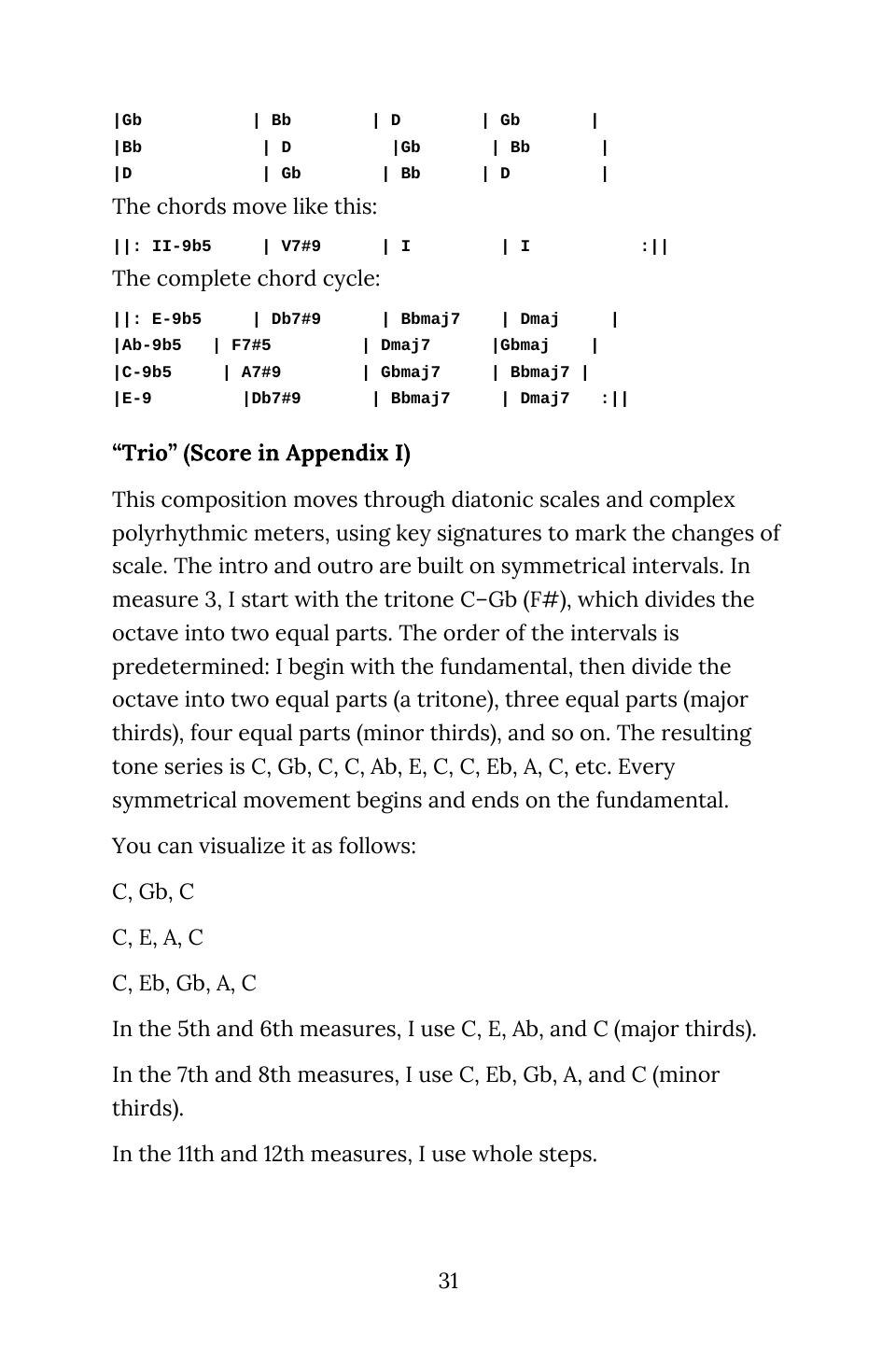
Before the drums come in, I use an extended technique to create harmonics: I pull off and hammer on the G string with my left hand while running my right index finger lightly across the same string to catch all the available harmonics. Rock guitarists made this technique popular. Harmonically, I use “multi-tonic” symmetrical key-center movement, here through D major, Gb major, and Bb major. My basic model was the progression II-7b5, V7#9, Imaj7. What I heard was a change of “key” center with every chord: I started on the II chord of D major (E-9b5), went to the V chord of Gb major (Db7#9), then to the I chord of Bb major (Bbmaj7), and finally to the I chord of D major (Dmaj7).
The key centers move like this: | Gb D |
The chords move like this:
The complete chord cycle:
“Trio”
This composition moves through diatonic scales and complex polyrhythmic meters, using key signatures to mark the changes of scale. The intro and outro are built on symmetrical intervals. In measure 3, I start with the tritone C–Gb (F#), which divides the octave into two equal parts. The order of the intervals is predetermined: I begin with the fundamental, then divide the octave into two equal parts (a tritone), three equal parts (major thirds), four equal parts (minor thirds), and so on. The resulting tone series is C, Gb, C, C, Ab, E, C, C, Eb, A, C, etc. Every symmetrical movement begins and ends on the fundamental.
You can visualize it as follows:
In the 5th and 6th measures, I use C, E, Ab, and C (major thirds).
In the 7th and 8th measures, I use C, Eb, Gb, A, and C (minor thirds).
In the 11th and 12th measures, I use whole steps.
Because each symmetrical movement begins and ends on C, the series often has repeated Cs from part to part and measure to measure. In measure 7, for example, one C ends the previous symmetry and the other begins the next: one closes the majorthird sequence, and the other opens the whole-tone sequence.
The outro was composed the same way.
The bulk of the piece follows a very specific rhythmic sequence, using groups of four, five, six, and seven quarter notes. The meters change according to the least common subdivision shared by the flute and trombone. If the trombone plays groups of six quarter notes (dotted whole notes) and the flute plays groups of four (whole notes), the measure might contain three whole notes or two dotted whole notes, giving a meter of 12/4. I could also have called it 3/1 or 4/1.5. The key signatures move with the same symmetrical motion. Starting at rehearsal letter B, I use a C key signature, then Gb, then C again; then key signatures in majorthird symmetry, C, E, Ab, and C. The whole piece moves this way.
Rehearsal letter A can be considered to have no key signature.
Over the course of the piece, the key signatures cycle through every symmetry possible within one octave of the chromatic scale: the tritone, major thirds, minor thirds, whole tones, and half steps. Quarter-note groupings from three to five are also explored.
In general, I feel rhythm as kick, snare, and hi-hat. The tambourine part realizes this idea: tambourine palm for what I would normally feel as the kick, tambourine normale for the hihat, and tambourine accent for what I hear as the snare.